Arpentage
Social Work (2024)
I attach particular importance to social justice and derive essential commitments from it:
I commit myself to the recognition of differences.
I commit myself to the fair distribution of resources.
I commit myself to exposing unjust practices.
I commit myself to honoring solidarity.
I commit myself to rejecting discrimination.*
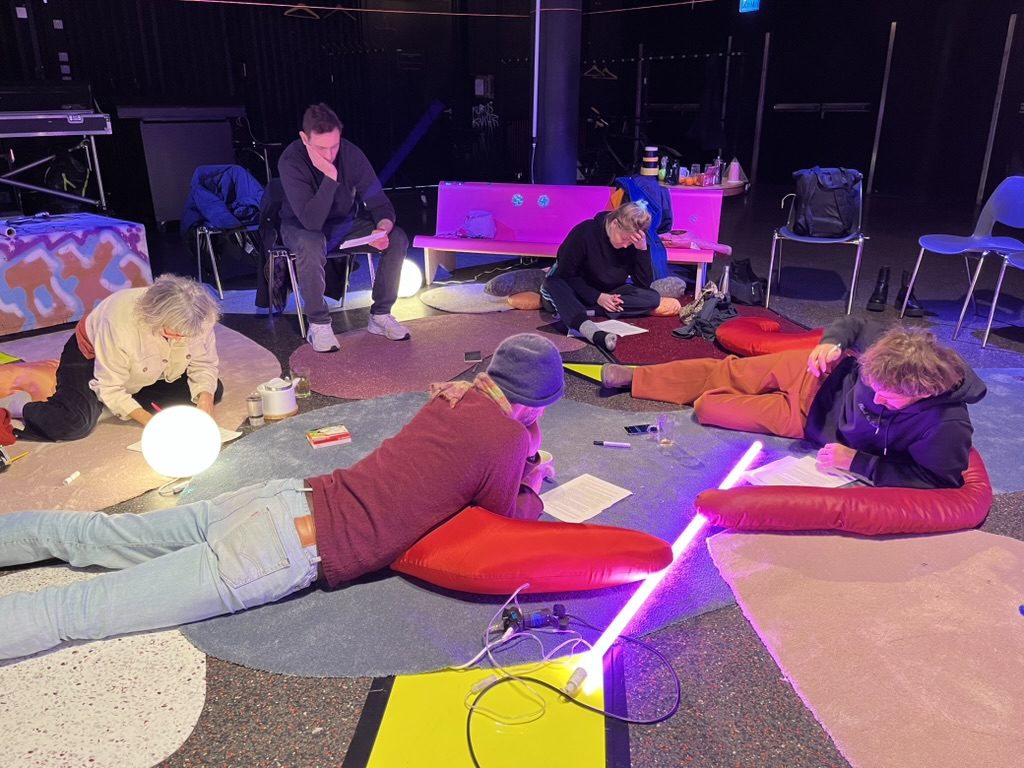
From this shared point of departure, an engagement with responsibility, social work, and empowerment unfolds. Only gradually does a conventional stage space emerge. At the center stands Édouard Louis’s «The End of Eddy»; not as a story to be told, but as shared material. The pages of the book are divided up; each person reads individually, language falters, wounds, or falls silent. Out of silence and reflection, free associations arise. Personal experiences, coming out, political questions, and impulses for action intertwine. Audience and performers enter into co-authorship, and the piece ends openly ; as an experience of language sometimes failing, and of how a shared space can emerge precisely from that absence.
* Code of Ethics, Social Work Switzerland
I commit myself to the recognition of differences.
I commit myself to the fair distribution of resources.
I commit myself to exposing unjust practices.
I commit myself to honoring solidarity.
I commit myself to rejecting discrimination.*
From this shared point of departure, an engagement with responsibility, social work, and empowerment unfolds. Only gradually does a conventional stage space emerge. At the center stands Édouard Louis’s «The End of Eddy»; not as a story to be told, but as shared material. The pages of the book are divided up; each person reads individually, language falters, wounds, or falls silent. Out of silence and reflection, free associations arise. Personal experiences, coming out, political questions, and impulses for action intertwine. Audience and performers enter into co-authorship, and the piece ends openly ; as an experience of language sometimes failing, and of how a shared space can emerge precisely from that absence.
* Code of Ethics, Social Work Switzerland
Credits
Direction and Dramaturgy:Ketty Ghnassia
Artistic Collaboration:
Noah Engweiler and Lukas Kubik
by and with:
Members of the Forum for Critical Social Work:
Rebecca Härtner, Emanuel Röhtlisberger;
Noah Engweiler (krilp),
Lukas Kubik and Sabina Winkler
Scenography and Costumes:
Sabina Winkler
Production Management:
Lukas Kubik
Supported by:
City of Zurich Department of Culture, Migros Culture Percentage, Cassinelli-Vogel Foundation, Ernst Göhner Foundation, Corymbo Foundation
A production by cie la mêlée, in co-production with Konzeptbüro and Rote Fabrik, and in cooperation with Theater Neumarkt
With special thanks to Lea Whitcher, Sabina Winkler, Kathrin Walde, and the project #carecity_stories for the loan of their scenography
About the process-based theatre work ARPENTAGE
Arpentage — roughly translated as « surveying » or « mapping » — is a practice that combines the proletarian reading circle with political action. It originated within the socialist movement in France, where workers’ associations and trade unions were looking for ways to educate themselves politically together without slipping into academic inertia. Reading was meant to function as empowerment at the same time: a tool for shaping political reality.The Arpentage project translates this principle into the present day and into the context of theatre.
Weiterführende Links