Arpentage
Journalism (2024)
Staging
of a fictional
JJS - meeting
on nursing pillows
Special agenda item: Arpentage of the essay «Das Prinzip Trotzdem» by Roger de Weck
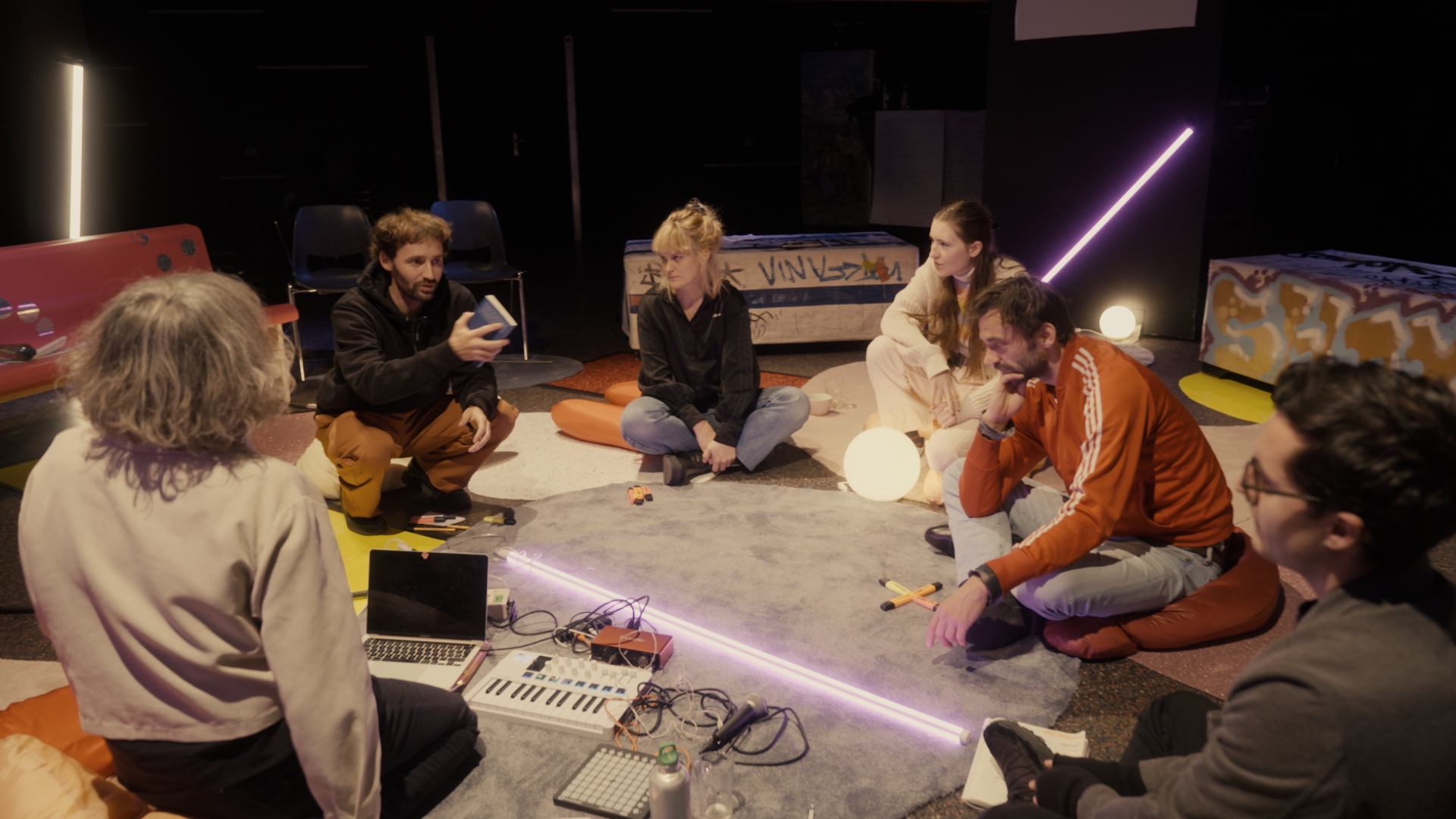
The professional collective Netzwerk Junge Journalistinnen & Journalisten Schweiz invites you to a fictional open session, in which not only organizational questions but also the crisis in journalism and possible courses of action are discussed. At the center is an arpentage drawn from the tradition of Éducation Populaire: under guidance, the audience reads Roger de Weck’s work «Das Prinzip Trotzdem». The pages are divided, each person highlights passages that are particularly relevant to them, and quietly reflects on their feelings, questions, and personal experiences.
While the book formulates abstract calls for responsibility and engagement, the piece shows—with humor and sensitivity to interpersonal dynamics—how collective engagement emerges and how political action can be rooted in everyday life.
of a fictional
JJS - meeting
on nursing pillows
Special agenda item: Arpentage of the essay «Das Prinzip Trotzdem» by Roger de Weck
The professional collective Netzwerk Junge Journalistinnen & Journalisten Schweiz invites you to a fictional open session, in which not only organizational questions but also the crisis in journalism and possible courses of action are discussed. At the center is an arpentage drawn from the tradition of Éducation Populaire: under guidance, the audience reads Roger de Weck’s work «Das Prinzip Trotzdem». The pages are divided, each person highlights passages that are particularly relevant to them, and quietly reflects on their feelings, questions, and personal experiences.
While the book formulates abstract calls for responsibility and engagement, the piece shows—with humor and sensitivity to interpersonal dynamics—how collective engagement emerges and how political action can be rooted in everyday life.
Credits
Direction and Dramaturgy:Ketty Ghnassia
Artistic Collaboration:
Noah Engweiler and Lukas Kubik
By and with:
Members of the Netzwerk Junge Journalistinnen & Journalisten Schweiz:
Sarina Höppner, Simon Schaffer;
Noah Engweiler (krilp),
Lukas Kubik, and Sabina Winkler
Scenography and Costumes:
Sabina Winkler
Production Management:
Lukas Kubik
Supported by:
City of Zurich Culture, Migros Kulturprozent, Cassinelli-Vogel Foundation, Ernst Göhner Foundation, Corymbo Foundation
A production of cie la mêlée in co-production with Konzeptbüro, Rote Fabrik, and in cooperation with Theater Neumarkt
Special thanks to Lea Whitcher, Sabina Winkler, Kathrin Walde, and the project #carecity_stories for lending their scenography
Roger de Weck, Das Prinzip Trotzdem © Suhrkamp Verlag GmbH, Berlin, 2024. Used with the kind permission of Suhrkamp Verlag.
About the process-based theatre work ARPENTAGE
Arpentage — roughly translated as « surveying » or « mapping » — is a practice that combines the proletarian reading circle with political action. It originated within the socialist movement in France, where workers’ associations and trade unions were looking for ways to educate themselves politically together without slipping into academic inertia. Reading was meant to function as empowerment at the same time: a tool for shaping political reality.Related Links